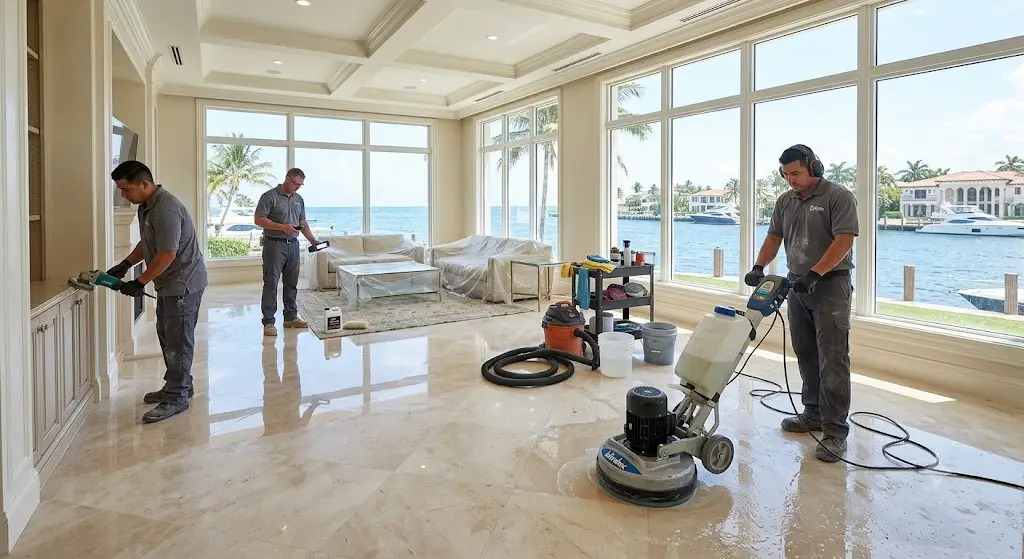
Professional marble restoration is one of the most effective ways to preserve the beauty, value, and longevity of natural stone surfaces. Over time, even the highest-quality marble floors can develop scratches, etching, dull areas, and wear patterns caused by foot traffic, environmental exposure, and everyday use.
Understanding the professional marble restoration process helps homeowners, estate managers, hospitality operators, and commercial property owners appreciate the expertise required to restore natural stone to its best possible condition.
What Is the Professional Marble Restoration Process?
The professional marble restoration process involves a series of specialized techniques designed to repair surface damage, enhance appearance, and protect the stone for the future.
Unlike routine cleaning, restoration addresses the actual condition of the stone surface by correcting imperfections and restoring its natural beauty.
Each project is customized based on the type of marble, the condition of the stone, and the client’s goals.
Step 1: Initial Inspection and Evaluation
Every successful restoration project begins with a detailed inspection.
A professional stone restoration specialist evaluates:
- Marble type
- Existing finish
- Scratches
- Etching
- Stains
- Grout condition
- Previous repairs
- Traffic patterns
This evaluation allows the restoration team to develop the most effective plan for the specific surface.
Proper assessment is critical because different marble varieties can respond differently to restoration techniques.
Step 2: Surface Preparation
Before restoration begins, the marble surface must be thoroughly cleaned.
Surface preparation may include:
- Removal of dirt and debris
- Deep cleaning
- Residue removal
- Protection of adjacent surfaces
- Preparation of work areas
A clean surface allows restoration equipment and polishing compounds to perform effectively.
Step 3: Honing the Marble Surface
Honing is often the most important stage of the professional marble restoration process.
During honing, specialized diamond abrasives are used to remove:
- Surface scratches
- Etching
- Minor stains
- Uneven wear patterns
- Dull areas
This process creates a smooth, uniform surface and prepares the marble for polishing.
Depending on the severity of the damage, multiple honing stages may be required.
Step 4: Marble Polishing
Once imperfections have been removed, polishing begins.
Professional polishing enhances:
- Reflectivity
- Clarity
- Surface smoothness
- Visual depth
- Overall appearance
The goal is to restore the luxurious shine and elegance that make marble such a desirable material in luxury homes and commercial properties.
Proper polishing requires specialized equipment, experience, and attention to detail.
Step 5: Grout and Detail Restoration
In many projects, restoration extends beyond the stone itself.
Additional services may include:
- Grout repair
- Grout cleaning
- Joint restoration
- Edge refinement
- Detail work around fixtures and transitions
These finishing touches contribute significantly to the overall appearance of the restored surface.
Step 6: Sealing and Protection
After polishing is complete, many marble surfaces benefit from professional sealing.
Sealing helps reduce the risk of:
- Staining
- Moisture penetration
- Contaminant absorption
While sealers do not make marble maintenance-free, they provide an additional layer of protection that helps preserve the results of the restoration process.
Step 7: Final Inspection
Before the project is completed, a final inspection ensures all restoration objectives have been achieved.
The inspection confirms:
- Consistent appearance
- Proper gloss levels
- Surface quality
- Client satisfaction
This final step helps ensure the restored marble meets professional standards.
Common Problems Marble Restoration Can Correct
Professional restoration can address many common issues, including:
- Etching
- Surface scratches
- Dull finishes
- Wear patterns
- Minor staining
- Uneven appearance
- Loss of shine
Many homeowners are surprised by how dramatically professional restoration can improve the appearance of existing stone surfaces.
Why Professional Restoration Matters
Natural stone represents a significant investment.
Professional restoration helps:
- Extend the lifespan of marble
- Preserve property value
- Improve aesthetics
- Reduce long-term replacement costs
- Maintain luxury appeal
In high-end residences, hospitality properties, yachts, and commercial spaces, maintaining natural stone surfaces is an important part of preserving the overall quality of the property.
Conclusion
The professional marble restoration process involves much more than simply cleaning a floor. Through careful inspection, honing, polishing, sealing, and quality control, professional restoration specialists can dramatically improve the appearance and longevity of marble surfaces.
Whether maintaining a luxury estate, commercial property, hospitality venue, or yacht, professional restoration remains one of the most effective ways to protect the beauty and value of natural stone investments.
Restore the Beauty of Your Marble Surfaces
Marble & Stone Estate specializes in luxury marble restoration, polishing, sealing, and natural stone preservation throughout South Florida.
Our team helps homeowners, estate managers, hospitality operators, and luxury property owners maintain the beauty, elegance, and value of their natural stone surfaces through expert restoration services.
Internal Links
luxury marble floors and property value
marble versus quartzite comparison
External Link
Disclaimer:
The information provided in this article is intended for general educational and informational purposes only. Natural stone surfaces vary widely in composition, finish, age, prior treatments, installation methods, and environmental exposure. Because of these variations, results may differ significantly from one surface to another.
Any maintenance suggestions, observations, or restoration discussions presented on this website should not be interpreted as a universal guarantee, a substitute for in-person professional inspection, or a recommendation to apply chemicals, abrasives, or corrective procedures without qualified evaluation.
Marble and Stone Estate is not responsible for damages, discoloration, etching, scratching, staining, structural issues, or loss of finish resulting from independent attempts to replicate procedures, use cleaning agents, or apply restoration methods based on website content without direct professional consultation.
Some stock photography, illustrative renderings, or visual representations used throughout this website may include digitally enhanced or AI-assisted images for conceptual, educational, or decorative purposes. Such images are used solely to help demonstrate stone conditions, restoration concepts, or visual examples and may not represent every exact material condition or restoration outcome.
For stone-specific recommendations, testing, or restoration guidance, an on-site professional assessment is always advised before attempting any treatment.
Also, natural stone has a personality of its own and occasionally refuses to cooperate with internet advice.