Marble Polishing vs. Marble Honing: What’s the Difference?
One of the most common questions homeowners and property managers ask is whether their marble floors need polishing or honing. While the two terms are often used interchangeably, they describe different processes that produce different results.
Understanding the difference can help you make informed decisions about maintaining the appearance and longevity of your marble surfaces.
Whether you own a waterfront estate in Lighthouse Point, manage a luxury condominium in Boca Raton, or oversee a hotel in Palm Beach County, knowing which finish is right for your property is an important part of caring for natural stone.
What Is Marble Honing?
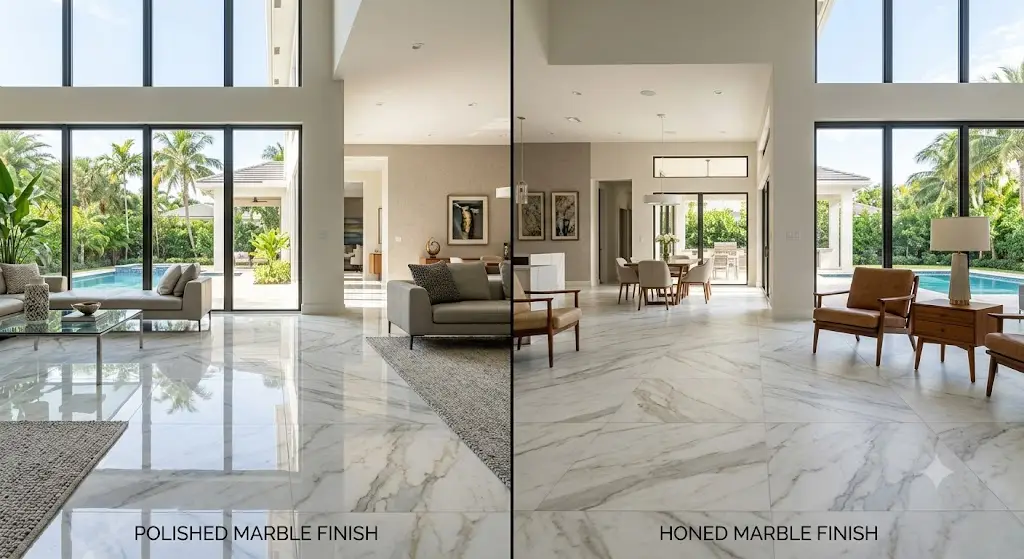
Honing is a process that smooths the marble surface to create a matte or satin finish.
Rather than producing a mirror-like shine, honing removes minor surface imperfections while leaving the stone with a softer, more natural appearance.
A honed finish is often chosen for:
- Entryways
- Bathrooms
- Kitchens
- Outdoor covered areas
- Contemporary home designs
Many homeowners appreciate that a honed finish tends to make light scratches and everyday wear less noticeable than a highly polished surface.
What Is Marble Polishing?
Polishing refines the marble surface to create a glossy, reflective finish.
This finish highlights the natural colors and veining within the stone, making it a popular choice for luxury homes, grand hotel lobbies, reception areas, and formal living spaces.
A polished marble floor can create an elegant first impression when it is properly maintained.
Which Finish Is Better?
Neither finish is universally better.
The right choice depends on several factors, including:
- The room’s purpose
- Amount of foot traffic
- Design preferences
- Lighting
- Maintenance expectations
For example, a formal foyer may benefit from polished marble, while a busy family kitchen may be better suited to a honed finish.
Can Marble Be Changed from One Finish to Another?
In many situations, yes.
Professional restoration techniques may allow marble to be converted from a polished finish to a honed finish, or from a honed finish back to a polished appearance.
The appropriate approach depends on the stone type, condition, and previous treatments.
Daily Care for Both Finishes
Regardless of the finish, marble benefits from consistent care.
Good habits include:
- Sweeping or dust mopping regularly
- Cleaning spills promptly
- Using cleaners made for natural stone
- Avoiding acidic household products
- Using protective pads under furniture
Simple preventive care helps preserve the appearance of both polished and honed marble.
Professional Evaluation Matters
Every marble floor is unique.
The stone type, age, previous maintenance, wear patterns, and existing condition all influence the best restoration approach.
A professional evaluation can help determine whether polishing, honing, or another maintenance service is the most appropriate option.
Conclusion
Both polished and honed marble offer timeless beauty. The best choice depends on your property’s style, how the space is used, and your maintenance goals.
Understanding the difference between these finishes allows homeowners and property managers to make informed decisions that help protect their investment for years to come.
OUTBOUND LINK
Natural Stone Institute marble care resources
Request a Professional Evaluation
Marble And Stone Estate Restoration And Maintenance LLC provides professional marble restoration and maintenance services for luxury estates, condominiums, hotels, resorts, yachts, commercial properties, country clubs, and government facilities throughout Broward County and neighboring counties north of Broward County.
Contact us to schedule a professional evaluation of your marble surfaces.
INTERNAL LINKS
How Luxury Marble Floors Influence Property Value in South Florida Estates
What Happens During a Professional Marble Restoration Project
Why High-End South Florida Estates Need More Than Basic Stone Cleaning
Marble Lobby Maintenance Strategies for Luxury Resorts
Disclaimer:
The information provided in this article is intended for general educational and informational purposes only. Natural stone surfaces vary widely in composition, finish, age, prior treatments, installation methods, and environmental exposure. Because of these variations, results may differ significantly from one surface to another.
Any maintenance suggestions, observations, or restoration discussions presented on this website should not be interpreted as a universal guarantee, a substitute for in-person professional inspection, or a recommendation to apply chemicals, abrasives, or corrective procedures without qualified evaluation.
Marble and Stone Estate is not responsible for damages, discoloration, etching, scratching, staining, structural issues, or loss of finish resulting from independent attempts to replicate procedures, use cleaning agents, or apply restoration methods based on website content without direct professional consultation.
Some stock photography, illustrative renderings, or visual representations used throughout this website may include digitally enhanced or AI-assisted images for conceptual, educational, or decorative purposes. Such images are used solely to help demonstrate stone conditions, restoration concepts, or visual examples and may not represent every exact material condition or restoration outcome.
For stone-specific recommendations, testing, or restoration guidance, an on-site professional assessment is always advised before attempting any treatment.
Also, natural stone has a personality of its own and occasionally refuses to cooperate with internet advice.