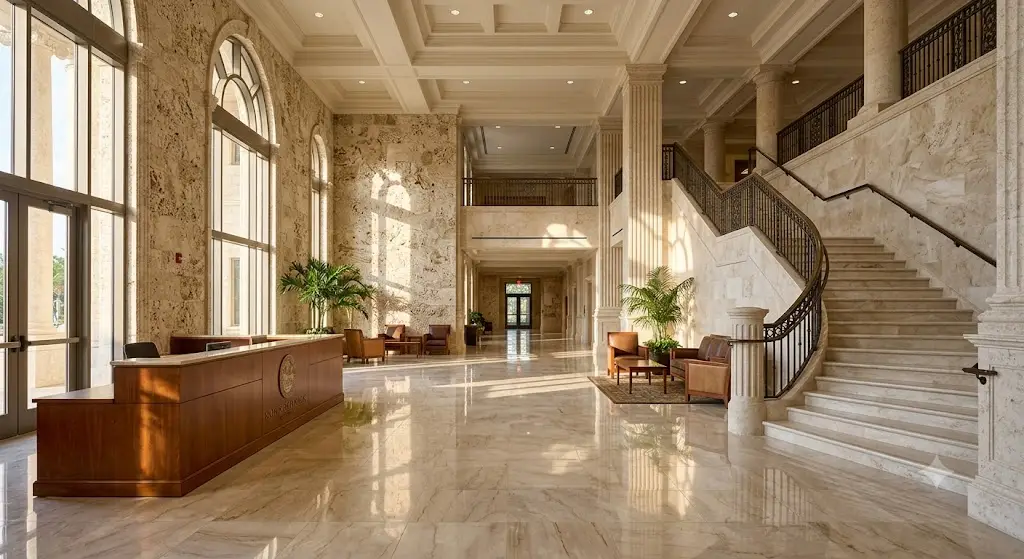
Government buildings and public facilities are designed to serve communities for decades. Courthouses, city halls, libraries, administrative offices, museums, public universities, transportation facilities, and civic centers often feature natural stone because of its durability, timeless appearance, and ability to withstand heavy daily use.
However, even the most durable stone surfaces are not immune to wear. Constant foot traffic, weather exposure, maintenance challenges, and aging can gradually diminish the appearance and performance of natural stone throughout public properties.
Proper stone care helps preserve both the appearance and long-term value of these important facilities while reducing the likelihood of costly repairs or premature replacement.
Why Natural Stone Is Common in Public Buildings
Natural stone has long been used in government and institutional architecture because it offers several advantages:
- Long service life
- Professional appearance
- Durability under heavy traffic
- Ease of restoration compared to replacement
- Historic and architectural significance
Materials such as marble, granite, limestone, terrazzo, travertine, and other natural stones are frequently found in:
- Entrance lobbies
- Hallways
- Public gathering areas
- Government offices
- Staircases
- Monuments
- Exterior plazas
- Courtyards
- Restrooms
- Public meeting facilities
When properly maintained, these surfaces can remain functional and attractive for generations.
The Challenges Public Facilities Face
Unlike private residences, government buildings often experience thousands of visitors every week.
This continuous use creates unique maintenance challenges, including:
Heavy Foot Traffic
Daily pedestrian traffic gradually wears away protective finishes and can create visible traffic patterns in stone flooring.
Over time, surfaces may appear dull even when they are regularly cleaned.
Dirt and Abrasive Debris
Sand, dirt, and other debris carried in from outside can act like sandpaper on polished stone surfaces.
Without effective entry matting and maintenance programs, this debris accelerates wear.
Weather Exposure
Exterior stone features are constantly exposed to:
- Rain
- Humidity
- UV exposure
- Wind-driven debris
- Seasonal temperature changes
South Florida’s climate can be especially demanding on exterior stone installations.
Maintenance Budget Constraints
Public facilities often operate under fixed budgets that must cover a wide range of building maintenance needs.
Preventive stone care is frequently more economical than addressing extensive deterioration later.
Interior Stone Maintenance Strategies
Routine maintenance plays a significant role in preserving public building stone surfaces.
Recommended practices include:
Regular Dust and Debris Removal
Removing abrasive particles before they are ground into the surface helps reduce unnecessary wear.
Appropriate Cleaning Products
Many common cleaning chemicals can damage natural stone.
Acidic or highly alkaline products may etch, discolor, or weaken certain stone types.
Using products designed specifically for natural stone helps minimize risk.
Periodic Professional Evaluation
Regular inspections can identify developing issues before they become major restoration projects.
Common concerns include:
- Surface dullness
- Etching
- Minor cracks
- Grout deterioration
- Slip resistance concerns
- Water intrusion
Early intervention is typically less disruptive and more cost-effective.
Exterior Stone Preservation
Government buildings often include outdoor stone features that require additional attention.
These may include:
- Entry plazas
- Walkways
- Memorials
- Monuments
- Courtyards
- Public gathering areas
Outdoor stone surfaces are exposed to weather, moisture, biological growth, and environmental contaminants.
Routine cleaning and preservation efforts can help maintain both appearance and safety.
Proper drainage management is also important, as standing water can contribute to staining and deterioration over time.
Historic Government Buildings Require Special Consideration
Many government facilities have historical significance.
Historic stone restoration often requires a more cautious approach than standard maintenance work.
Preservation efforts should focus on:
- Retaining original materials whenever possible
- Minimizing unnecessary removal of stone
- Using appropriate restoration techniques
- Respecting architectural integrity
Every historic property presents unique challenges and should be evaluated individually.
Restoration vs. Replacement
When stone surfaces begin showing wear, replacement is not always necessary.
Professional restoration may address issues such as:
- Surface dullness
- Minor etching
- Scratches
- Staining
- Loss of reflectivity
- General wear patterns
In many situations, restoration can extend the useful life of existing stone while helping facilities avoid the expense and disruption associated with replacement projects.
Planning for Long-Term Facility Management
Stone care should be viewed as part of a facility’s long-term asset management strategy.
A structured maintenance plan may include:
- Routine cleaning schedules
- Periodic inspections
- Preventive maintenance
- Restoration planning
- Documentation of stone conditions
This approach helps facility managers make informed decisions while protecting public investments.
Conclusion
Government buildings and public facilities serve important roles within their communities. Natural stone surfaces contribute to the professional appearance, durability, and architectural character of these properties.
With proper maintenance, periodic evaluations, and timely restoration when necessary, natural stone can continue serving the public for many years while preserving the appearance and value of public facilities.
If your government facility, public institution, courthouse, civic center, or municipal property contains natural stone surfaces, professional evaluation can help identify maintenance opportunities before small issues become larger expenses.
For additional industry information regarding natural stone preservation and maintenance, facility managers may consult the Natural Stone Institute.
Natural stone preservation guidance
Request a Professional Evaluation
Marble And Stone Estate Restoration And Maintenance LLC provides professional stone restoration and maintenance services for government, institutional, commercial, and luxury properties throughout Broward County and neighboring counties north of Broward County.
To discuss your facility’s stone maintenance needs, contact our team for a professional evaluation.
INTERNAL LINKS
professional marble restoration project
commercial stone restoration reduces long-term maintenance costs
protecting exterior stone surfaces from South Florida weather
Disclaimer:
The information provided in this article is intended for general educational and informational purposes only. Natural stone surfaces vary widely in composition, finish, age, prior treatments, installation methods, and environmental exposure. Because of these variations, results may differ significantly from one surface to another.
Any maintenance suggestions, observations, or restoration discussions presented on this website should not be interpreted as a universal guarantee, a substitute for in-person professional inspection, or a recommendation to apply chemicals, abrasives, or corrective procedures without qualified evaluation.
Marble and Stone Estate is not responsible for damages, discoloration, etching, scratching, staining, structural issues, or loss of finish resulting from independent attempts to replicate procedures, use cleaning agents, or apply restoration methods based on website content without direct professional consultation.
Some stock photography, illustrative renderings, or visual representations used throughout this website may include digitally enhanced or AI-assisted images for conceptual, educational, or decorative purposes. Such images are used solely to help demonstrate stone conditions, restoration concepts, or visual examples and may not represent every exact material condition or restoration outcome.
For stone-specific recommendations, testing, or restoration guidance, an on-site professional assessment is always advised before attempting any treatment.
Also, natural stone has a personality of its own and occasionally refuses to cooperate with internet advice.