What Happens During a Professional Travertine Restoration Project
Travertine is one of the most elegant natural stones used throughout luxury homes and commercial properties. You’ll find it around pools, patios, driveways, walkways, lanais, courtyards, and interior floors because of its timeless beauty and naturally slip-resistant texture.
Over time, however, even premium travertine begins to show its age. Dirt becomes trapped inside its pores, foot traffic wears away the finish, weather causes discoloration, and old sealers start to fail. Many property owners assume the stone has reached the end of its life when, in reality, professional restoration can often make it look dramatically better without replacing it.
Knowing what happens during a professional travertine restoration project helps homeowners understand why proper restoration produces results that simple cleaning cannot.
Step 1: Complete Stone Evaluation
Every restoration begins with a detailed inspection.
A professional evaluates:
- Surface wear
- Cracks or chips
- Loose or hollow tiles
- Missing grout
- Stains
- Water damage
- Previous sealers
- Uneven areas
- Drainage concerns for outdoor installations
No two travertine floors or patios age the same way. Understanding the condition of the stone determines the safest restoration process.
Step 2: Deep Cleaning
Years of embedded dirt cannot simply be washed away with household cleaners.
Professional equipment removes:
- Embedded soil
- Mold and mildew
- Algae
- Organic staining
- Calcium buildup
- Old waxes
- Residue from improper cleaners
For outdoor travertine in South Florida, this step is especially important because humidity and frequent rain encourage biological growth.
After cleaning, the true condition of the stone becomes visible.
Step 3: Repairs
Once the stone is clean, damaged areas can be addressed.
Common repairs include:
- Filling small holes
- Repairing chips
- Replacing damaged grout
- Stabilizing loose pieces
- Repairing cracked sections when possible
These repairs help restore both the appearance and structural integrity of the surface.
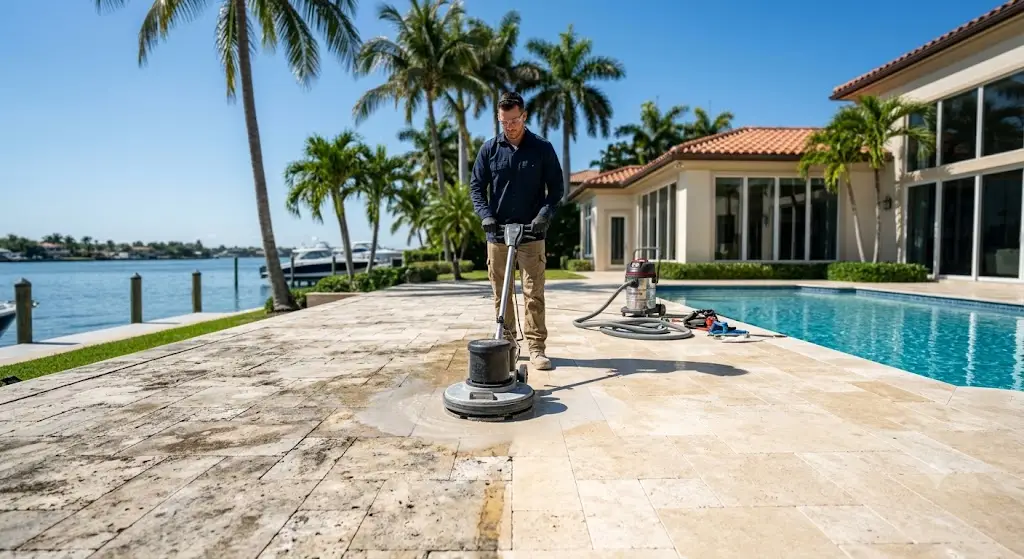
Step 4: Honing the Surface
Honing removes minor imperfections while creating a fresh, even finish.
Depending on the customer’s preference, honing can:
- Remove scratches
- Eliminate etching
- Smooth worn traffic paths
- Blend repaired areas
- Prepare the stone for sealing
Unlike polishing marble to a mirror finish, travertine is often left with a natural satin appearance that complements both indoor and outdoor spaces.
Step 5: Sealing the Travertine
Travertine is naturally porous.
Without proper sealing, moisture and contaminants can penetrate the stone, leading to staining and premature deterioration.
Professional sealers help protect against:
- Water absorption
- Oil stains
- Dirt penetration
- Mold growth
- Everyday wear
Choosing the correct sealer depends on whether the stone is installed indoors or outdoors.
Step 6: Final Inspection
Before completing the project, the restored surface is inspected to ensure consistent results throughout the installation.
The final walkthrough confirms:
- Uniform appearance
- Proper repairs
- Even finish
- Complete cleaning
- Proper sealing
- Customer satisfaction
Attention to detail is what separates professional restoration from temporary cosmetic improvements.
Why Professional Restoration Is Worth It
Replacing travertine can be expensive, disruptive, and unnecessary.
Professional restoration often allows homeowners to preserve their existing investment while dramatically improving its appearance.
Proper restoration can:
- Extend the life of the stone
- Improve safety
- Enhance curb appeal
- Protect property value
- Reduce long-term maintenance costs
Routine maintenance after restoration also helps keep travertine looking beautiful for years.
Trust Experienced Craftsmanship
Luxury natural stone deserves specialized care.
Whether your travertine surrounds a pool, welcomes guests at your front entrance, or enhances an elegant outdoor living space, professional restoration helps preserve its natural character while protecting your investment.
At Marble And Stone Estate Restoration and Maintenance LLC, we specialize in restoring premium natural stone surfaces with careful attention to detail and craftsmanship tailored to each project.
Conclusion
Travertine is designed to last for decades when properly maintained.
If your stone has become dull, stained, worn, or weathered, restoration may be the ideal solution before considering replacement. A professional restoration project can revive the beauty of your natural stone while helping it withstand years of future use.
Luxury surfaces deserve master craftsmanship.
Disclaimer:
The information provided in this article is intended for general educational and informational purposes only. Natural stone surfaces vary widely in composition, finish, age, prior treatments, installation methods, and environmental exposure. Because of these variations, results may differ significantly from one surface to another.
Any maintenance suggestions, observations, or restoration discussions presented on this website should not be interpreted as a universal guarantee, a substitute for in-person professional inspection, or a recommendation to apply chemicals, abrasives, or corrective procedures without qualified evaluation.
Marble and Stone Estate is not responsible for damages, discoloration, etching, scratching, staining, structural issues, or loss of finish resulting from independent attempts to replicate procedures, use cleaning agents, or apply restoration methods based on website content without direct professional consultation.
Some stock photography, illustrative renderings, or visual representations used throughout this website may include digitally enhanced or AI-assisted images for conceptual, educational, or decorative purposes. Such images are used solely to help demonstrate stone conditions, restoration concepts, or visual examples and may not represent every exact material condition or restoration outcome.
For stone-specific recommendations, testing, or restoration guidance, an on-site professional assessment is always advised before attempting any treatment.
Also, natural stone has a personality of its own and occasionally refuses to cooperate with internet advice.