Terrazzo Floor Maintenance for Commercial Buildings
Terrazzo has a reputation for being beautiful, durable, and practical, which is one reason it continues to appear in commercial buildings, offices, hotels, public facilities, transportation buildings, and other high-traffic properties.
Its smooth appearance and distinctive aggregate patterns can give a building an upscale, finished look without requiring the constant replacement associated with some other flooring materials.
But low maintenance does not mean no maintenance.
Commercial terrazzo floors deal with something residential floors usually don’t: thousands of footsteps, carts, equipment, dirt, spills, and daily traffic. Without a consistent maintenance program, even a well-installed terrazzo floor can eventually lose its appearance.
The good news is that proper maintenance can help preserve terrazzo and keep a commercial property looking professional.
Why Terrazzo Works Well in Commercial Buildings
Terrazzo can be made with aggregates such as marble, granite, glass, and other materials combined with a cementitious or epoxy binder. The finished surface can be polished to create a smooth, attractive floor.
That versatility makes terrazzo suitable for many commercial environments, including:
- Office buildings
- Hotels and resorts
- Retail properties
- Lobbies
- Government facilities
- Schools and institutions
- Convention centers
- Airports and transportation facilities
- Corporate headquarters
For a business, the floor is more than something people walk on. It is part of the building’s first impression.
High Traffic Changes the Maintenance Equation

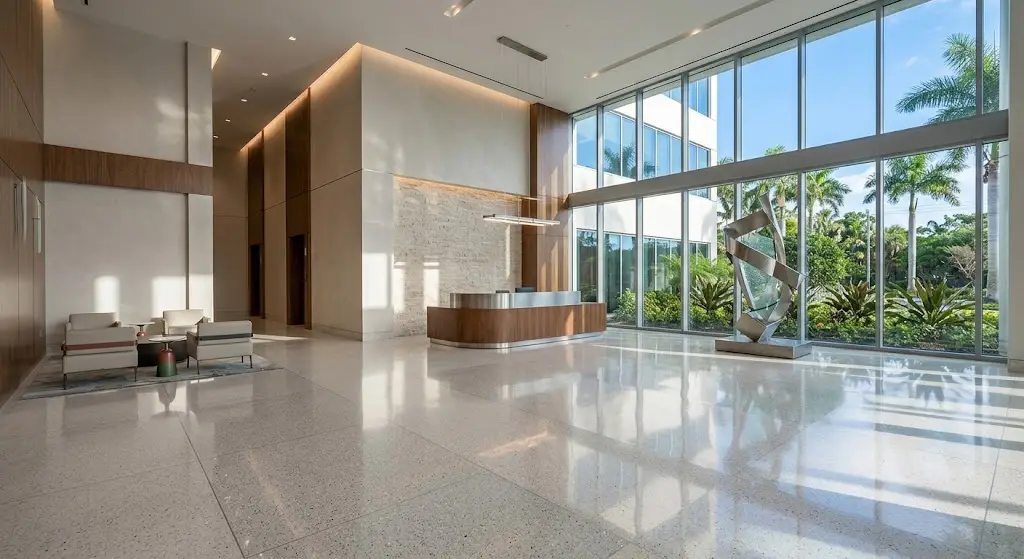
A commercial lobby may look beautiful in the morning and show signs of traffic by the end of the day.
Dirt and grit carried in from outside can act as an abrasive against hard flooring surfaces. Spills that are ignored can become more difficult to remove. High-traffic paths may gradually look different from areas that receive little use.
That is why commercial terrazzo maintenance should be based on the actual traffic and conditions of the building rather than a one-size-fits-all schedule.
How Commercial Stone Restoration Reduces Long-Term Maintenance Costs
Daily Maintenance Matters
One of the simplest ways to protect terrazzo is to remove loose dirt before it has an opportunity to wear against the surface.
Regular dust mopping and appropriate cleaning can help reduce the accumulation of abrasive debris.
recommends routine dust mopping and the use of products appropriate for terrazzo as part of a maintenance program.
Entryways deserve particular attention because they are where outdoor dirt, sand, and moisture are most likely to enter the building.
The National Terrazzo & Mosaic Association
Spills Should Not Be Ignored
Commercial buildings see plenty of spills.
Coffee, food, beverages, cleaning products, and other substances can end up on the floor throughout the day.
Cleaning spills promptly can help reduce the chance of staining or residue becoming a larger maintenance problem. The NTMA specifically recommends cleaning spills as quickly as possible to help prevent staining and damage.
This is one of those simple maintenance tasks that costs very little compared with repairing a neglected floor.
Use the Right Cleaning Products
Terrazzo should not be treated like every other hard flooring material.
Using inappropriate chemicals or aggressive cleaning methods may damage the surface or leave unwanted residue.
Commercial maintenance teams should use products and procedures appropriate for the particular terrazzo system and follow manufacturer recommendations.
When there is uncertainty about an older or unusual terrazzo installation, professional evaluation is a sensible first step.
What Happens When Terrazzo Starts Looking Dull?
A terrazzo floor may gradually lose some of its original appearance as it experiences years of traffic.
You may notice:
- Dull areas
- Uneven appearance
- Scuff marks
- Embedded dirt
- Surface wear
- Staining
- Loss of polish
At this stage, simply cleaning the floor may not be enough.
Depending on the condition of the floor, professional maintenance or restoration may help improve its appearance without replacing the existing terrazzo.
The NTMA notes that terrazzo can be repaired and re-polished even after many years of use.
Commercial Restoration Requires Planning
Restoring a commercial floor is different from restoring a small residential room.
A commercial property may need to remain operational while work is performed.
That means the restoration plan may need to consider:
- Business hours
- Employee traffic
- Customer traffic
- Building access
- Furniture
- Safety requirements
- Work zones
- Cleaning schedules
A professional evaluation can help determine the appropriate restoration approach and how the work can be organized around the property’s operations.
Don’t Wait Until the Floor Looks Bad
Preventive maintenance is generally easier than trying to recover a floor that has been neglected for years.
A commercial terrazzo maintenance program may include routine cleaning, periodic evaluation, professional polishing when appropriate, and attention to damaged or heavily worn areas.
The exact schedule depends on the building.
A busy commercial lobby may require a different approach from a private office with limited foot traffic.
Protecting the Building’s Professional Image
A clean, well-maintained terrazzo floor can contribute to the overall appearance of a commercial property.
This matters particularly in spaces where clients, residents, guests, employees, or visitors enter the building every day.
A beautifully maintained floor can complement architecture, lighting, furniture, and other design elements rather than competing with them.
In a luxury hotel lobby or corporate entrance, those details matter.
Stone Care for Government Buildings and Public Facilities
Conclusion
Terrazzo is known for its durability and relatively straightforward maintenance, but even durable flooring needs a plan.
Regular cleaning, prompt attention to spills, appropriate maintenance products, and professional evaluation when the surface begins to show wear can help commercial property owners protect their terrazzo floors for the long term.
For commercial buildings in South Florida, maintaining the existing terrazzo may be a much smarter approach than waiting until the floor requires major intervention.
Request a Professional Evaluation
Marble And Stone Estate Restoration And Maintenance LLC provides professional natural stone and terrazzo restoration and maintenance services for commercial buildings, luxury properties, hotels, resorts, country clubs, government facilities, and other high-end properties throughout Broward County and counties north of Broward County.
If your terrazzo floor has become dull, worn, stained, or difficult to maintain, contact Marble And Stone Estate to discuss a professional evaluation and determine whether maintenance or restoration may be appropriate for your property.
National Terrazzo & Mosaic Association maintenance guidance
Disclaimer:
The information provided in this article is intended for general educational and informational purposes only. Natural stone surfaces vary widely in composition, finish, age, prior treatments, installation methods, and environmental exposure. Because of these variations, results may differ significantly from one surface to another.
Any maintenance suggestions, observations, or restoration discussions presented on this website should not be interpreted as a universal guarantee, a substitute for in-person professional inspection, or a recommendation to apply chemicals, abrasives, or corrective procedures without qualified evaluation.
Marble and Stone Estate is not responsible for damages, discoloration, etching, scratching, staining, structural issues, or loss of finish resulting from independent attempts to replicate procedures, use cleaning agents, or apply restoration methods based on website content without direct professional consultation.
Some stock photography, illustrative renderings, or visual representations used throughout this website may include digitally enhanced or AI-assisted images for conceptual, educational, or decorative purposes. Such images are used solely to help demonstrate stone conditions, restoration concepts, or visual examples and may not represent every exact material condition or restoration outcome.
For stone-specific recommendations, testing, or restoration guidance, an on-site professional assessment is always advised before attempting any treatment.
Also, natural stone has a personality of its own and occasionally refuses to cooperate with internet advice.