Why Luxury Hotels Invest in Routine Stone Floor Maintenance
Luxury hotels are built around details.
From the lighting and furniture to the lobby design and guest rooms, every element contributes to the experience. Natural stone floors are often one of those details guests notice without even realizing it.
Marble, travertine, limestone, granite, and other natural stones can create an elegant appearance that fits perfectly within a luxury hotel. But these floors also experience something that residential stone usually does not: constant traffic.
Guests arrive with luggage. Staff move equipment through hallways. Events bring additional visitors. Restaurants create spills. Outdoor areas introduce dirt, moisture, and debris.
Over time, even beautiful stone can begin to show the effects.
That is why luxury hotels invest in routine stone floor maintenance rather than waiting until the floor requires major restoration.
WHY HOTEL STONE FLOORS NEED ROUTINE CARE
A hotel floor can experience thousands of footsteps in a short period of time.
The main entrance, lobby, elevators, corridors, restaurants, and other common areas often receive continuous traffic throughout the day.
Dirt and grit brought in from outside can gradually wear against the surface. Spills can leave stains or residue. Frequently used walking paths can begin to look different from areas that receive less traffic.
Routine maintenance helps address these issues before they become more noticeable.
THE LOBBY MAKES THE FIRST IMPRESSION
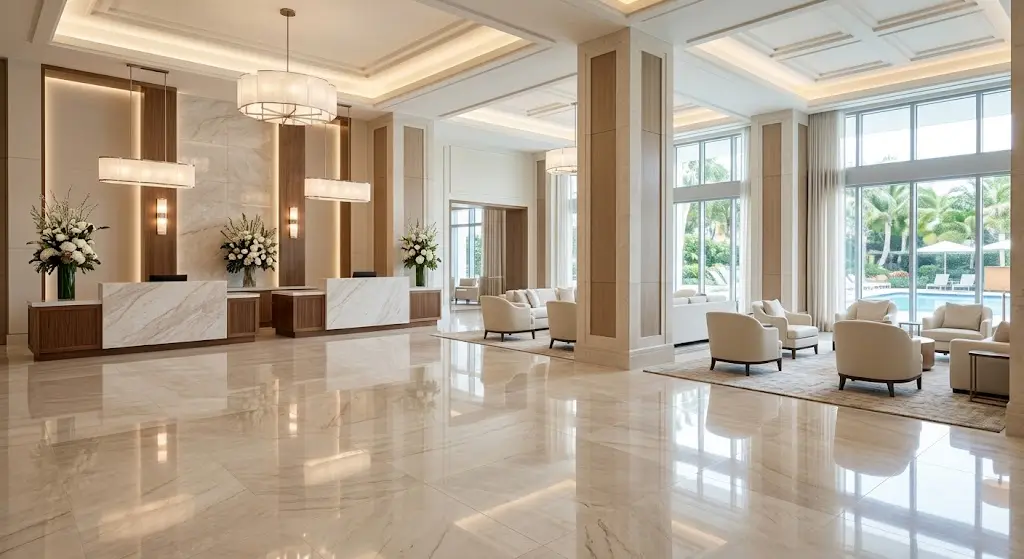
For many luxury hotels, the lobby is one of the most important spaces in the property.
Guests may immediately notice a polished marble floor, large stone entrance, or dramatic architectural feature.
A floor that looks dull, dirty, or heavily worn can affect the overall impression of an otherwise beautiful property.
This is one reason professional hotels treat stone maintenance as part of property presentation rather than simply another cleaning task.
Marble Lobby Maintenance Strategies for Luxury Resorts
PROTECTING HIGH-TRAFFIC AREAS
Not every area of a hotel receives the same amount of use.
The entrance and lobby may experience constant traffic, while a private hallway or restricted area may receive considerably less.
A good maintenance plan should take these differences into account.
High-traffic areas may need more frequent attention, while lower-traffic areas can often follow a different schedule.
This approach allows property managers to focus resources where they have the greatest effect.
SPILLS ARE PART OF HOTEL LIFE
Hotels deal with food, beverages, events, restaurants, room service, and countless other activities every day.
A spill that is cleaned promptly may be a minor inconvenience.
A spill that sits on a stone surface for too long can become a more difficult maintenance problem.
Staff should know which cleaning products are appropriate for the particular stone and finish rather than assuming that every floor can be treated the same way.
Natural stone requires the right approach.
DIFFERENT STONES REQUIRE DIFFERENT CARE
Marble is not granite.
Granite is not travertine.
Travertine is not limestone.
Although these materials are all natural stone, their characteristics and finishes can differ significantly.
A maintenance program should take the specific stone into account, along with whether the surface is polished, honed, textured, or finished in another way.
This is especially important in luxury hotels where several types of stone may exist within the same property.
WHEN CLEANING IS NO LONGER ENOUGH
Routine cleaning can remove dirt and surface residue, but sometimes a floor needs more than cleaning.
Property managers may eventually notice:
Dull areas
Loss of polish
Worn traffic paths
Persistent stains
Scratches
Uneven appearance
Surface buildup
When these conditions appear, professional evaluation can help determine whether the floor needs maintenance, polishing, honing, restoration, or another treatment.
Waiting until the entire floor looks severely worn can make the project more complicated.
ROUTINE MAINTENANCE CAN HELP CONTROL LONG-TERM COSTS
Stone flooring represents a significant investment in many luxury properties.
Replacing a large stone floor can be disruptive and expensive.
Routine maintenance is one way property owners can help protect that investment.
Professional maintenance does not necessarily mean performing major restoration every year. In many cases, the objective is to keep the stone in good condition so that larger problems are less likely to develop.
This can also help property managers plan maintenance instead of reacting to an emergency.
How Commercial Stone Restoration Reduces Long-Term Maintenance Costs
MAINTENANCE SHOULD FIT THE HOTEL’S SCHEDULE
A hotel cannot simply stop operating because a floor needs attention.
Guests are arriving. Events are scheduled. Restaurants are operating. Employees are working.
Professional stone maintenance therefore needs to be planned around the property’s operations.
Depending on the location and condition of the stone, work may be scheduled during lower-traffic periods or divided into manageable sections.
Good planning can help reduce disruption while still keeping the property looking its best.
LUXURY IS IN THE DETAILS
Guests may not know the technical difference between polishing and honing.
They may not know which type of stone is installed beneath their feet.
But they notice when a luxury property feels clean, cared for, and well maintained.
That is the real value of routine stone floor maintenance.
It helps preserve the appearance of the property while supporting the overall experience the hotel is trying to create.
CONCLUSION
Luxury hotels invest in routine stone floor maintenance because their floors are constantly working.
They welcome guests, support daily operations, handle heavy traffic, and contribute to the property’s overall appearance.
Regular maintenance can help preserve natural stone, address small problems before they become larger ones, and protect the investment that went into the property.
For hotels and resorts in South Florida, a thoughtful stone maintenance program can be especially valuable because humidity, rain, outdoor traffic, and year-round activity create additional demands on natural stone.
Professional evaluation can help determine the right maintenance approach for each property and each stone surface.
Natural Stone Institute stone care resources
PROFESSIONAL HOTEL STONE CARE
Marble And Stone Estate Restoration And Maintenance LLC provides professional natural stone restoration and maintenance for luxury hotels, resorts, condominiums, estates, yachts, country clubs, government facilities, and commercial properties throughout Broward County and counties north of Broward County.
If your hotel’s marble, travertine, granite, limestone, or other natural stone surfaces are showing signs of wear, contact Marble And Stone Estate to discuss a professional evaluation.
Luxury Surfaces Deserve Master Craftsmanship.
Disclaimer:
The information provided in this article is intended for general educational and informational purposes only. Natural stone surfaces vary widely in composition, finish, age, prior treatments, installation methods, and environmental exposure. Because of these variations, results may differ significantly from one surface to another.
Any maintenance suggestions, observations, or restoration discussions presented on this website should not be interpreted as a universal guarantee, a substitute for in-person professional inspection, or a recommendation to apply chemicals, abrasives, or corrective procedures without qualified evaluation.
Marble and Stone Estate is not responsible for damages, discoloration, etching, scratching, staining, structural issues, or loss of finish resulting from independent attempts to replicate procedures, use cleaning agents, or apply restoration methods based on website content without direct professional consultation.
Some stock photography, illustrative renderings, or visual representations used throughout this website may include digitally enhanced or AI-assisted images for conceptual, educational, or decorative purposes. Such images are used solely to help demonstrate stone conditions, restoration concepts, or visual examples and may not represent every exact material condition or restoration outcome.
For stone-specific recommendations, testing, or restoration guidance, an on-site professional assessment is always advised before attempting any treatment.
Also, natural stone has a personality of its own and occasionally refuses to cooperate with internet advice.